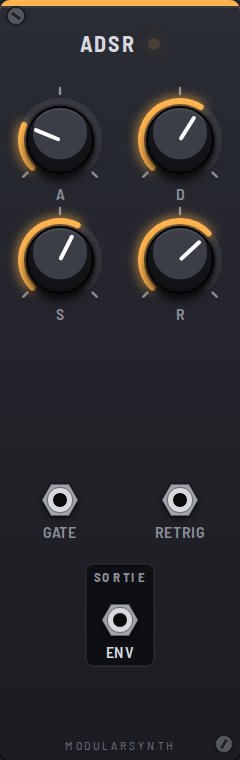
The ADSR draws how a note changes over time, in four stages. It puts out a voltage from 0 to 10 V, most often used to drive a VCA (the volume) or a filter's cutoff (the brightness). Each voice gets its own envelope.
Controls
- A (Attack): how long it takes to rise from 0 to 10 V after you press a key, from 1 ms to 10 s.
- D (Decay): how long it takes to fall to the sustain level.
- S (Sustain): the level held while the key stays down, from 0 to 1 (that is, 0 to 10 V).
- R (Release): how long it takes to fade back to silence once you let go.
The stages are exponential, like a capacitor charging in an analog circuit: the rise slows down as it nears its goal, which sounds natural.
Inputs
- Gate: starts the envelope when it goes above 1 V, and starts the release when it drops back down.
- Retrig: a rising edge restarts the attack even while the gate stays high (handy with an LFO for repeated notes).
Output
- Env: the envelope, from 0 to 10 V.
Try this in the inspector
Watch Env and play a note: you see the rise, the fall to the sustain level, the flat plateau, then the release tail. A short A with S at zero gives a percussive sound (a pluck); a long A gives a pad that swells in gently.