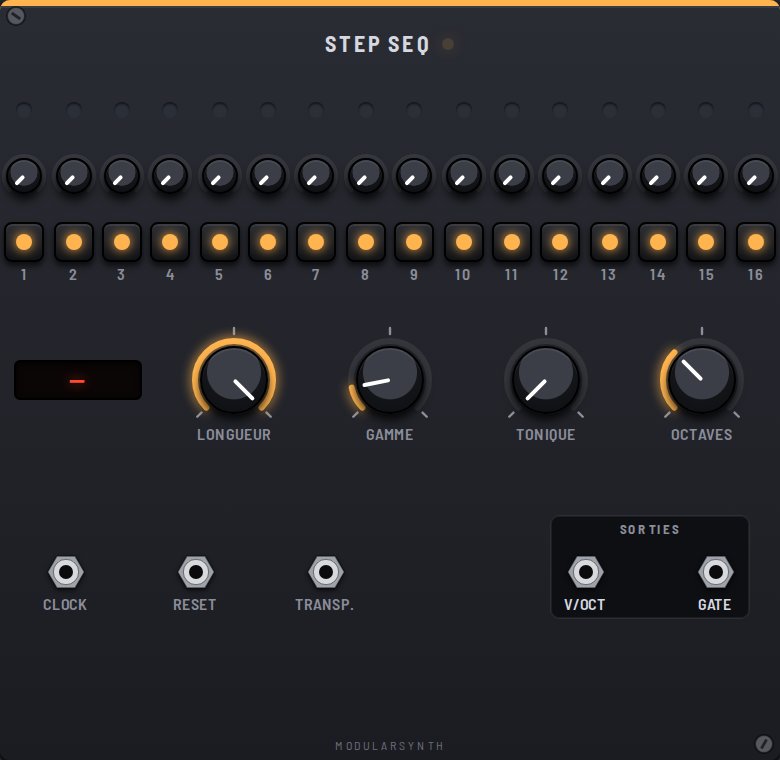
The Step Seq loops a short melody of 16 notes. On each rising edge at its CLOCK input, it moves to the next step; the LED above the playing step lights up.
The row of steps
Each step has a small knob and a button numbered 1 to 16. The knob sets the pitch of the note; while you turn it, its name shows up (for example "D#4"). The button turns the step's gate on or off: a step that is off keeps its note but triggers nothing, which makes rests.
Controls
- Length: number of steps played before looping back (1 to 16). With 12 steps on a 16-step clock, the pattern shifts every bar.
- Scale: the notes allowed. "FREE" lets the voltage through as it is; the other scales snap each step to the nearest in-tune note, so nothing can sound off.
- Root: the starting note of the scale (C, D…).
- Octaves: range of the step knobs, from 1 to 4 octaves.
Inputs
- Clock: moves one step forward on each rising edge.
- Reset: gets ready to go back to the start; the next clock edge plays step 1.
- Transp: voltage added to the output, at 1 V/octave (+1/12 V per semitone). A MIDI→CV keyboard patched here transposes the sequence.
Outputs
- V/Oct: the pitch of the current step, to patch into a VCO.
- Gate: 10 V during the clock pulse, only on steps that are on; patch it into an ADSR envelope.