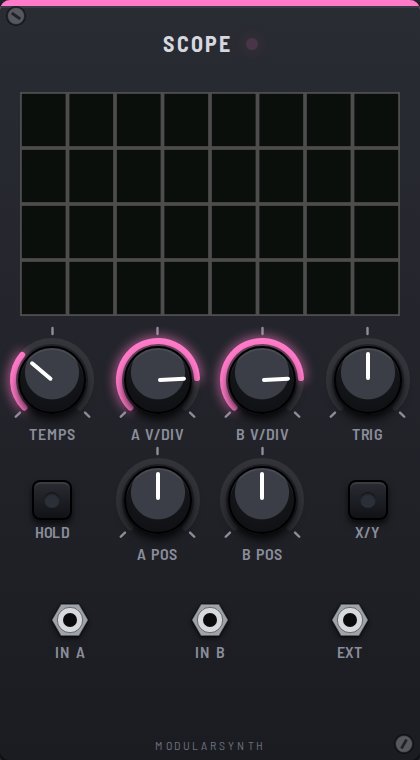
The Scope shows the signals arriving at its inputs, right in the rack. It changes nothing and makes no sound: it is a measuring tool, like the oscilloscope on an electronics workbench. All its controls are on the panel.
Inputs
- In A: first signal, drawn in green; by default it is the one that triggers the picture.
- In B: second signal, drawn in purple, to compare two points of the patch.
- Ext: external trigger; when patched, it sets where the picture starts (a gate, a clock).
On a polyphonic cable, every sounding voice is drawn: the loudest one bright (it is the one that triggers), the others paler.
Controls
- Time: how much time fits across the whole width, from 2 ms to 3 s. Short to see the shape of an audio wave, long to follow an LFO or an envelope: a fast sound then shows up as a solid band, its envelope.
- A V/div and B V/div: volts per vertical square (4 squares); 2.5 V/div shows ±5 V.
- A pos and B pos: move each trace up or down.
- Trig: trigger level; the picture starts when the signal rises above this threshold, which keeps it steady.
- Hold: freezes the picture so you can study it.
- X/Y: draws B against A; two sine waves make a Lissajous figure.