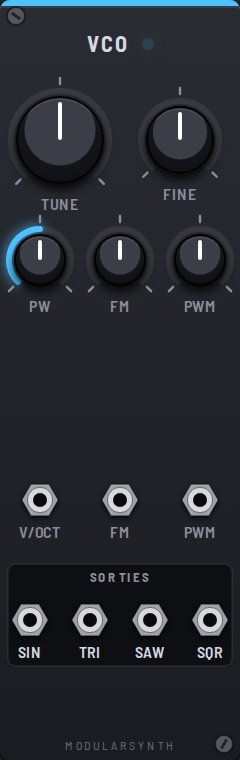
The VCO (Voltage Controlled Oscillator) makes the basic sound: a wave that repeats at the frequency of the note. Its pitch follows the voltage at V/Oct: +1 V doubles the frequency. It offers four waveforms, all at ±5 V.
Waveforms
- Sin: a pure sine wave, with no harmonics. Soft, almost a flute.
- Tri: triangle, a few quiet odd harmonics.
- Saw: sawtooth, very rich in harmonics: the basis of synth strings and brass.
- Sqr: square (or pulse), odd harmonics, a hollow, clarinet-like sound.
Controls
- Tune: offset in octaves (oct), from −4 to +4.
- Fine: fine tuning in semitones (st), from −1 to +1.
- PW: pulse width of the square; at 0.5 it is a perfect square, at the extremes a thin, nasal pulse.
- FM: depth of frequency modulation from the FM input.
- PWM: depth of pulse width modulation from the PWM input.
Inputs
- V/Oct: the pitch (often from MIDI→CV).
- FM: a signal that moves the pitch (a slow LFO gives a vibrato).
- PWM: a signal that moves the pulse width (a slow LFO gives a chorus-like effect).
Try this in the inspector
Watch Saw on the spectrum: a row of evenly spaced lines that get smaller. The saw and square waves are smoothed by PolyBLEP anti-aliasing: go very high up in pitch and see the spectrum stay clean.