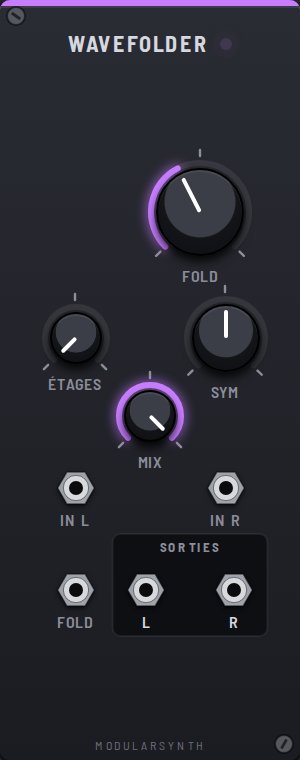
A distortion clips: past a threshold, the signal gets flattened. The Wavefolder does the opposite: when the signal goes past the threshold, it comes back down, like a wave curling over. The more you amplify, the more times the wave folds, and the more harmonics appear — without the level ever going past ±5 V. This is the sound of Buchla and Serge synths, from a simple triangle or sine.
Controls
- Fold: the gain before folding, from ×1 to ×32. At ×1 the sound passes almost untouched; as you turn it up, the wave folds more and more and the tone turns bright, then metallic.
- Stages: from 1 to 3 folding cells in a row. Each stage folds the result of the one before: the spectrum gets denser and harder to predict.
- Sym: offsets the signal before folding. At zero, the spectrum stays symmetrical (odd harmonics); as you move it away from the center, even harmonics appear, rounder and more nasal.
- Mix: the balance between the original sound and the folded sound.
Folding runs at four times the sample rate, so harmonics that are too high do not fold back into stray frequencies.
Inputs
- In L, In R: the sound to process (In R copies In L).
- Fold: folding CV (+1 V = twice as much folding).
Outputs
- L, R: the folded sound, in stereo.