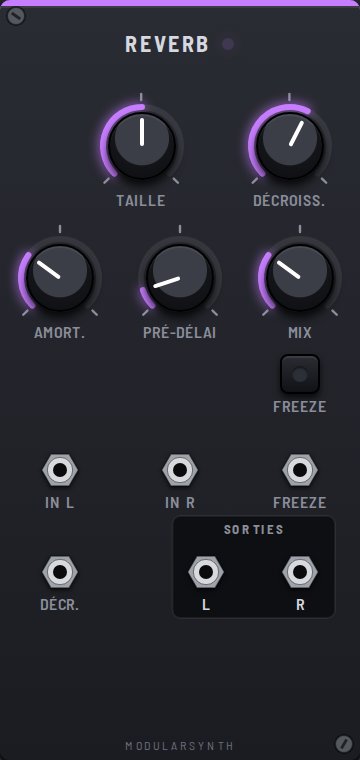
In a room, a sound bounces off the walls thousands of times, and those reflections melt into a tail that slowly fades. A reverb imitates this tail with delay lines (like the ones in the Delay) that pass the sound back and forth.
This module follows the algorithm Jon Dattorro published in 1997, which imitates a studio "plate": a big sheet of metal set vibrating. The sound first goes through four all-pass filters that scatter it, then circles in a tank shaped like a figure eight: two branches that hand the signal to each other, a little quieter on every lap. The tank delays move very slightly, which avoids metallic ringing. The left and right outputs are picked up at seven different points: they never sound alike, which gives the stereo width.
Controls
- Size: length of the delays, from a small room to a cathedral.
- Decay: how much sound is kept on each lap, so how long the tail lasts.
- Damp: highs fade faster than lows, just like in a real hall.
- Pre-delay: time before the reverb starts (up to 200 ms); it keeps the attack of the sound crisp.
- Mix: balance between the dry sound and the reverb. Alone on an Aux send, turn it all the way up; after a Delay, keep some dry sound so the echoes stay clear.
- Freeze: holds the sound in the tank forever and shuts the input.
Inputs
- In L, In R: the sound to process (In R copies In L).
- Freeze: a gate freezes the reverb while it is high.
- Decay: CV for the decay, added to the knob.
Outputs
- L, R: the reverb in stereo.