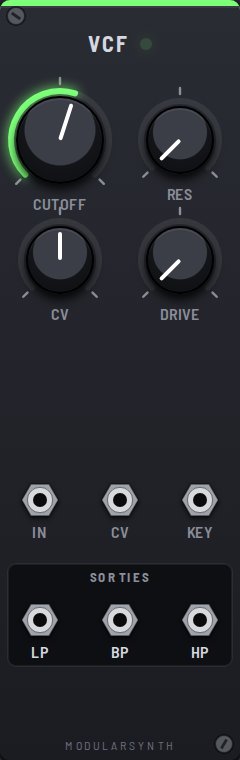
The VCF (Voltage Controlled Filter) shapes the tone by taking frequencies away. It is a 12 dB per octave state-variable filter, with three outputs at once. It stays stable even when you modulate its cutoff very fast.
Controls
- Cutoff: the cutoff frequency, from 20 Hz to 20 kHz (logarithmic scale).
- Res: resonance; it boosts the frequencies near the cutoff, all the way to a whistle.
- CV: depth (positive or negative) of the modulation coming into the CV input.
- Drive: gentle saturation of the input signal, to warm it up.
Inputs
- In: the signal to filter (often the saw of a VCO).
- CV: cutoff modulation at 1 V/octave, scaled by the CV knob (an LFO or an envelope).
- Key: keyboard tracking; patch V/Oct here so the brightness follows the note you play.
Outputs
- LP: low-pass, keeps the lows (the most used).
- BP: band-pass, keeps a band around the cutoff.
- HP: high-pass, keeps the highs.
Try this in the inspector
Watch the LP output on the spectrum and turn Cutoff: the lines above the cutoff collapse. Then raise Res: a peak shows up on the spectrum at the cutoff frequency, and the scope shows a small ringing added on top of the wave.