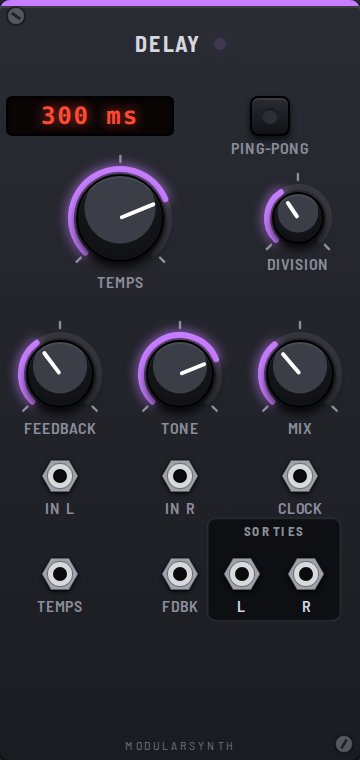
A delay repeats the sound after a short moment, like an echo in the mountains. Inside, a delay line keeps the last few seconds of the signal in memory and plays them back; it is the basic building block of almost every space effect (chorus, flanger, reverb).
Controls
- Time: the gap between two echoes, from 1 ms to 2 s, shown at the top.
- Division: when a clock is patched into CLOCK, the time follows the tempo: 1/8 = an eighth note, 1/8. = a dotted eighth (the "bouncing" echo), 1/8T = a triplet.
- Feedback: how much of the echo is sent back into the line, so how many repeats you hear. Above 1, the echoes never stop, but a gentle limiter keeps them from running away.
- Tone: a filter inside the loop; on each pass, the echo loses some highs, like an old tape delay.
- Mix: the balance between the original sound (dry) and the echoes (wet).
- Ping-pong: the echoes bounce between left and right.
Inputs
- In L, In R: the sound to process (In R copies In L when it is not patched).
- Clock: a clock (the ×4 output of the Clock); the time becomes its period × the division, and the display shows the division.
- Time: CV for the time (+1 V = twice as long). Fdbk: CV for the feedback, added to the knob.
Outputs
- L, R: the processed sound, in stereo.
When you turn Time while playing, the delay glides instead of jumping: the pitch bends up or down for a moment, like a tape speeding up.