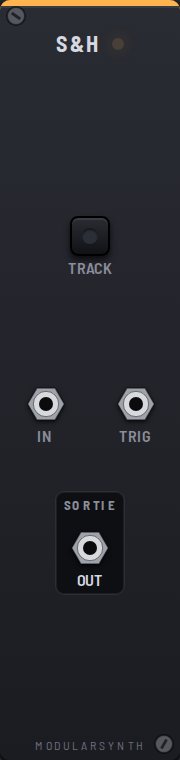
A sample & hold "takes a snapshot" of a voltage at a precise moment and keeps it until the next snapshot. It turns a sliding source (an LFO, noise) into a series of fixed values, like stairs. Patch it into a Quant and you get an arpeggio.
Controls
- Track: off, the module is a true Sample & Hold (it grabs a value on the rising edge of Trig and keeps it). On, it is a Track & Hold: the output follows In while Trig is high, then keeps the last value as soon as it drops.
Inputs
- In: the voltage to remember. With no cable here, the S&H samples an internal noise between −5 V and +5 V: on each edge, a new random pick. It is the random source of the rack.
- Trig: the moment of the snapshot. In Sample mode, only the rising edge (going above 1 V) counts: a gate that stays high does not grab a new value. Patch in a clock, a sequencer gate, a square LFO.
Both inputs are polyphonic: each voice has its own memory, and its own randomness if Trig is polyphonic (with a mono Trig and In unpatched, a single random pick serves every voice).
Outputs
- Out: the held value. In Sample mode, it only changes on Trig edges; in Track mode, it follows In while the gate is high. It sits at 0 V before the first edge.