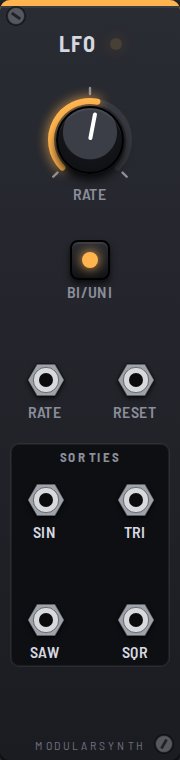
The LFO (Low Frequency Oscillator) is an oscillator too slow to hear: from 0.01 Hz (one cycle every 100 seconds) up to 50 Hz. It is not made to play a sound. It brings other settings to life: vibrato, tremolo, filter sweeps.
Controls
- Rate: how fast it swings, in hertz (Hz), on a logarithmic scale.
- Bi/Uni: bipolar (from −5 to +5 V, around zero) or unipolar (from 0 to 10 V). Bipolar is good for moving a setting up and down around its value. Unipolar suits a setting that should only go up.
Inputs
- Rate: changes the speed, at 1 V per octave (+1 V doubles the speed).
- Reset: a rising edge restarts the cycle from zero. For example, reset it on every note so the sweep always starts from the same point.
Outputs
- Sin: sine wave, a smooth and steady motion.
- Tri: triangle, straight rise and straight fall.
- Saw: saw wave, slow rise then a sudden drop.
- Sqr: square, flips between two values (a trill effect).
Try this in the inspector
Watch Sin: the scope shows a very slow curve. Patch it into the CV input of the VCF and turn up the filter's CV knob: the sound "breathes". With a fast Sqr into the FM input of a VCO, you get a trill between two notes.