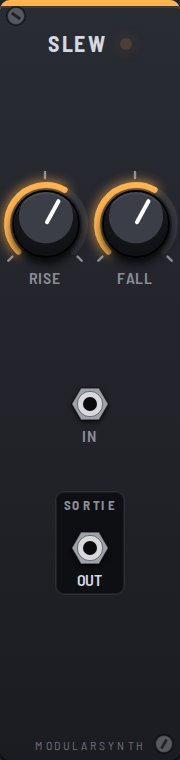
A Slew limits how fast a voltage can change. When the input jumps, the output does not catch up at once: it ramps up or down, at a speed you set. The name comes from slew rate, the fastest change a circuit can make.
It is an all-purpose smoother: on a pitch, it gives portamento (the glide between two notes); on the stairs of an S&H, it softens them; on a gate, it makes a rough envelope that rises and falls back.
Controls
- Rise: the time to go up one volt, from 1 ms to 2 s. It applies when the input is higher than the output.
- Fall: the time to go down one volt. The two are independent: you can rise fast and fall slowly.
The time is given per volt, so per octave when you smooth a V/Oct pitch: at 100 ms, a fifth (0.58 V) takes 58 ms, an octave takes 100 ms.
Inputs and outputs
- In: the voltage to smooth (polyphonic: each voice has its own slope).
- Out: the smoothed voltage. At startup, it jumps straight to the input value. Note: the MIDI→CV sends 0 V (a C4) until a note is played, so the first keyboard note glides up from that C4; the next ones start from the previous note.