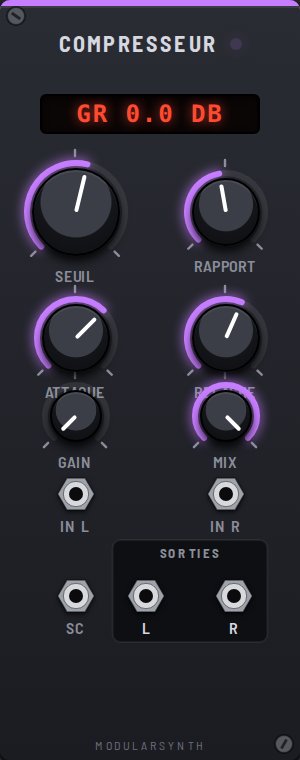
A compressor is an automatic volume control: when the sound gets louder than a threshold, it turns the gain down to shrink the gap between loud and quiet parts. The sound gets denser, more "glued"; you can then bring it back up without clipping. It measures the peak level on both sides at once, so the sound never leans to one side.
Controls
- Thresh: the level (in dB) above which compression starts. The lower it is, the more it works.
- Ratio: how much the overshoot gets reduced. At 4:1, a sound 12 dB above the threshold now only goes 3 dB over; at 20:1, you are close to a limiter.
- Attack: how fast it reacts to a loud sound. Slow, it lets the start of each note through (the "snap").
- Release: how fast it goes back to normal gain. Too short, the sound "pumps"; too long, it stays squashed.
- Gain: makeup gain, to give back the lost level (up to +24 dB).
- Mix: the balance between the original sound and the compressed one. Halfway, you get parallel compression: the punch of the dry sound plus the density of the compressed one.
The display shows the gain reduction live: the "GR" in dB.
Inputs
- In L, In R: the sound to process (In R copies In L).
- SC: sidechain. When patched, the level is measured on this signal instead of the processed sound: another sound makes it duck.
Outputs
- L, R: the compressed sound, in stereo.