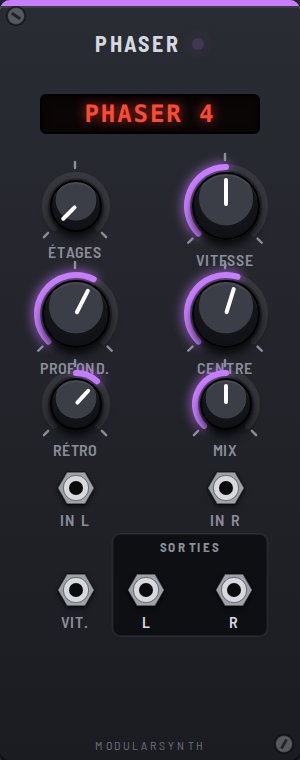
The sound goes through a chain of all-pass filters: they leave every level untouched, but delay each frequency by a different amount, which means they shift its phase. Mixed with the original sound, this phase shift cancels the signal where it reaches 180°: you get notches, one per pair of stages. An LFO keeps moving the frequency of these filters, so the notches sweep across the spectrum and the sound "swirls".
The phaser is a cousin of the flanger in the Chorus: the flanger carves dozens of evenly spaced dips (a comb), the phaser carves just a few, spaced more freely.
Controls
- Stages: 4, 6, 8 or 12 all-pass filters, giving 2, 3, 4 or 6 notches. The more there are, the more glassy the effect.
- Rate: speed of the sweep, from 0.02 to 8 Hz.
- Depth: width of the sweep, up to 3 octaves on each side of the center.
- Center: the frequency the notches wander around.
- Fdbk: feedback; it deepens and narrows the notches. Negative, it gives a more hollow sound.
- Mix: at halfway, the notches are at their deepest.
The right LFO is offset by a quarter cycle, so the two sides never move together.
Inputs
- In L, In R: the sound to process (In R copies In L).
- Rate: CV for the speed (+1 V = twice as fast).
Outputs
- L, R: the processed sound, in stereo.