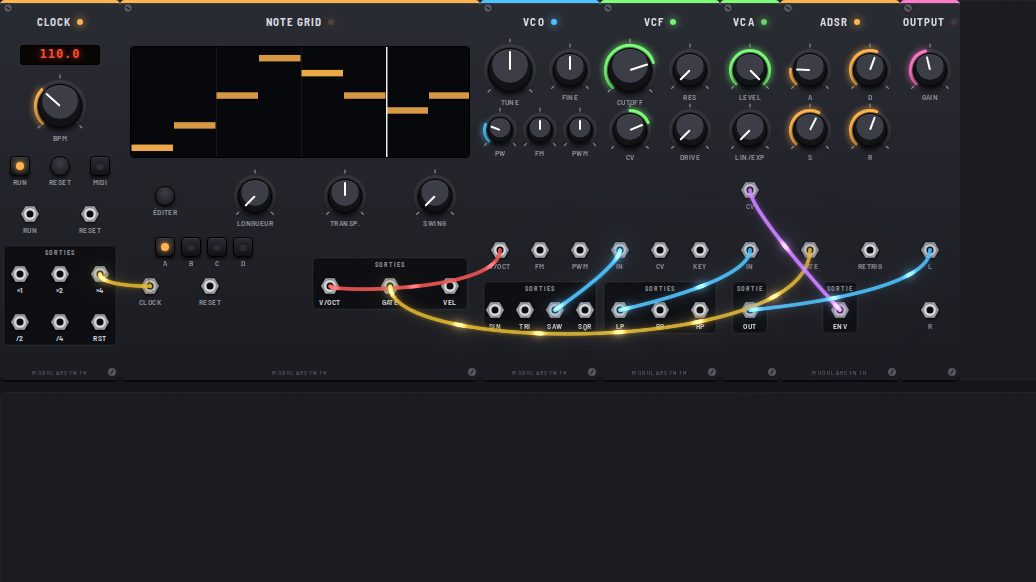
This chapter is an aside: six small experiments on a ready-made instrument that plays by itself. You have nothing to build, only to listen to what changes when you touch a setting.
You discover the big ideas of modular: everything is voltage, a modulation can be dosed and inverted with an Attenuverter, a fast enough modulation becomes a sound, the ADSR shapes a note, the Quant keeps randomness on a scale, and the waveform gives a sound its character. The exercises can be done in any order.
The exercises
- Everything is voltage
By the end: One LFO moves the filter, the pitch and the tone: in modular, everything is voltage, and any voltage can drive any setting. - Scale and invert
By the end: The Attenuverter sets how much modulation you get, flips it, and shifts it: a faucet for voltage. - When modulation becomes sound
By the end: Sped up into hearing range, a vibrato becomes a tone: modulation and sound are the same thing at different speeds. - The shape of a note
By the end: With the ADSR’s knobs, you turned the same melody into a plucked sound, then into a pad. - Notes that always fit
By the end: Randomness, passed through the Quant, only plays notes from a scale: a melody that invents itself and always fits. - Waveforms
By the end: Sine, triangle, square, sawtooth: the wave’s shape gives the sound its character, even before the filter.