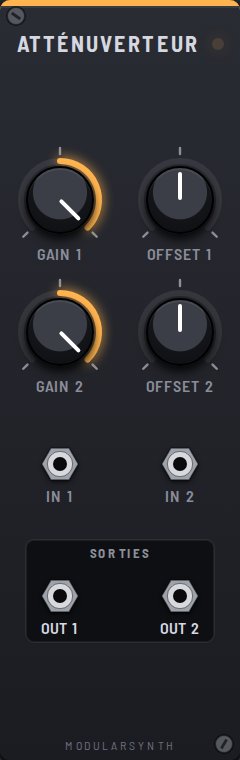
An attenuverter (a blend of attenuate and invert) scales a control voltage: it shrinks it, flips it, or shifts it. This module holds two of them, side by side and fully independent. You will reach for them all the time in a modular rack.
Each channel simply works out output = input × gain + offset.
Controls
- Gain 1 and Gain 2: the factor applied to the input, from −1 to +1. At +1, the signal goes through as it is; at 0.2, it is five times smaller; at −1, it is flipped (up becomes down). This is the attenuator you need so an LFO swinging ±5 V only moves a setting by ±1 V.
- Offset 1 and Offset 2: a voltage added to the result, from −5 V to +5 V. It re-centers a signal, or lifts it above zero.
Inputs and outputs
- In 1 and In 2: the voltages to process, polyphonic (each voice is worked out on its own). An empty input counts as 0 V.
- Out 1 and Out 2: the result.
With no cable on the input, the channel becomes a fixed voltage source: its output is exactly Offset. It is the easiest way to hand another module a pitch or a threshold you set by hand.