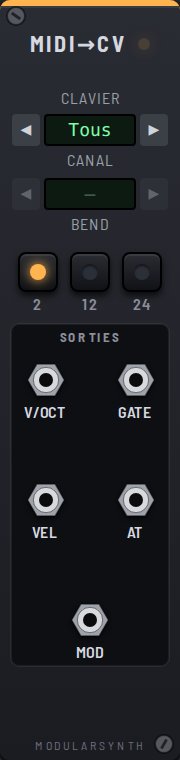
This module is where playing begins: it turns the notes you play (computer keyboard, on-screen keyboard or MIDI keyboard) into voltages that other modules understand. It is polyphonic: each note takes one voice, and each output carries as many channels as there are voices (⚙ menu, "Voices").
Keyboard, channel, bend
The top screen picks what the module listens to. Keyboard: "All", "Computer" (keys, on-screen keyboard, AI) or a connected MIDI keyboard, by name. With two keyboards, each MIDI→CV plays its own part. Channel only applies to one specific MIDI keyboard: "All" or a channel from 1 to 16, to split the two halves of a split keyboard. Bend sets the pitch bend range: 2, 12 or 24 semitones.
Outputs
- V/Oct: the pitch, at 1 volt per octave. Middle C (C4) is 0 V, the next C up is 1 V. Patch it into the V/Oct input of a VCO.
- Gate: 10 V while the key is held down, 0 V otherwise. It triggers an ADSR envelope.
- Vel: velocity from 0 to 10 V, to shape the volume or the filter.
- AT: aftertouch, the pressure you keep on a key of a MIDI keyboard, from 0 to 10 V.
- Mod: the mod wheel (CC1), from 0 to 10 V.
Voice allocation
A new note takes the next free voice. If all of them are busy, the oldest one is "stolen": its gate drops to 0 V for an instant so the envelope starts again. While the sustain pedal (CC64) is down, released notes keep ringing until you let go of it.