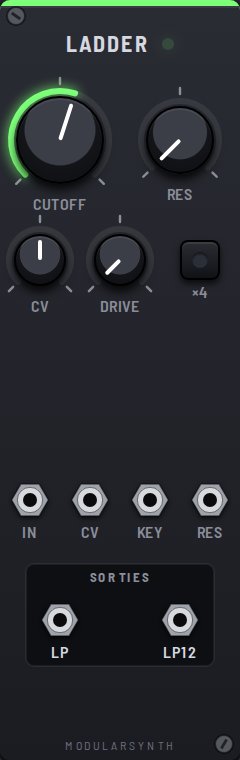
The Ladder is a four-pole low-pass filter: four stages stacked like the rungs of a ladder. Each one weakens the highs by 6 dB per octave, so 24 dB in all, steeper than the VCF. Part of the output feeds back into the input (the resonance), and each stage saturates, like the transistors in a real Moog. Hence its fat, warm character.
Controls
- Cutoff: the cutoff frequency, from 20 Hz to 20 kHz.
- Res: the resonance. A peak forms at the cutoff. Near the top, the filter self-oscillates: it sings with no input at the Cutoff frequency, a sine wave of about 1 V peak at full resonance (up to around 15 kHz). As on a real Moog, the bass fades as the resonance goes up.
- CV: how far the CV input moves the cutoff (at full, 1 V = one octave).
- Drive: the gain before the saturation, from 1 to 4.
- ×4: runs the filter at four times the sample rate. It removes stray frequencies folded back by the saturation and tunes the self-oscillation better, but uses more CPU. Either way, the filter delays the sound by 0.3 ms.
Inputs and outputs
- In: the sound. CV: the cutoff. Key: keyboard tracking. Res (the jack): the resonance, ±10 V for ±1.
- LP: 24 dB per octave. LP12: the same filter tapped after two stages, at 12 dB. Compare them on the Scope.