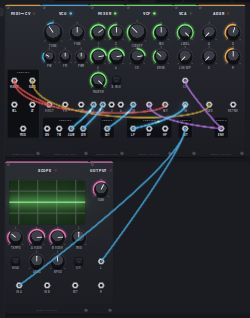
Pluck bass
One voice, a closed filter opened by a very short envelope: a plucked attack. Mod wheel: widens the square wave’s pulse, hollowing the sound.
OpenThe 27 presets are ready-made patches: to discover what ModularSynth can do, to learn by looking at how they are patched, or as a starting point for your own sounds. They are also in the Library, in the top bar.
The Open button loads the preset into the synth. If you have a patch open, ModularSynth asks before replacing it.
One voice, a closed filter opened by a very short envelope: a plucked attack. Mod wheel: widens the square wave’s pulse, hollowing the sound.
Open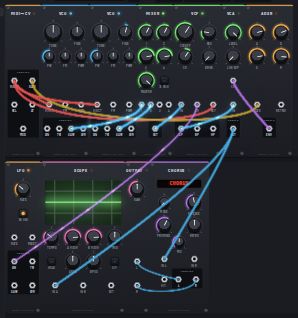
Eight voices, two detuned saws, a breathing filter, slow attack and release, widened to stereo by a chorus. Mod wheel: speeds up the chorus until it shimmers.
Open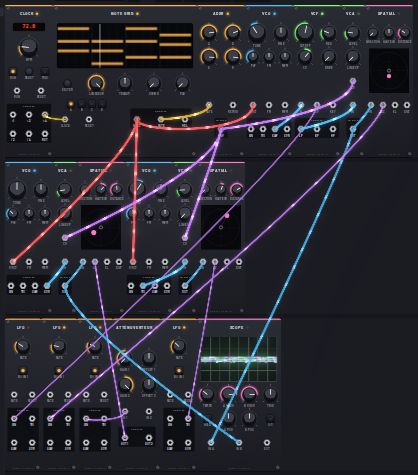
Three pads play A minor, F, C, G by themselves; each has its own Spatial: the low one circles close by, the middle one the other way and higher up, the high one faster and farther away (pick the rendering in ⚙).
Open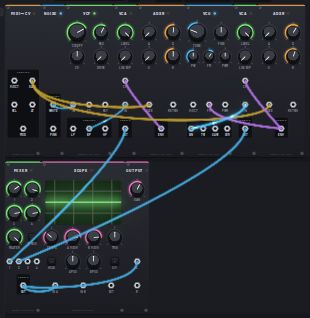
Band-pass filtered noise (snare) and a sine whose pitch drops (kick), two short envelopes.
Open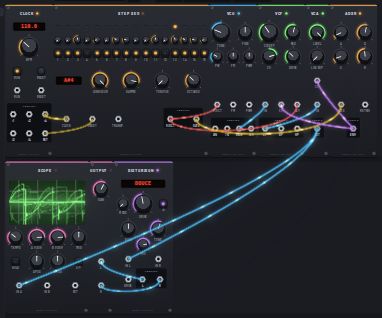
No keyboard needed: a clock runs 16 steps of driven bass in minor pentatonic. ▶/■ to start or stop.
Open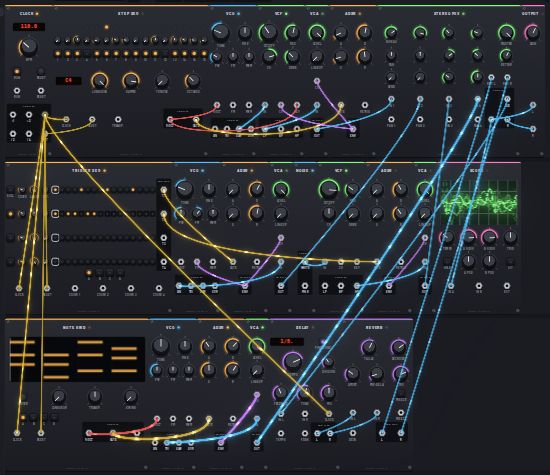
Step Seq bass, Trigger Seq drums and Note Grid chords on one clock, mixed in stereo with ping-pong delay and reverb.
Open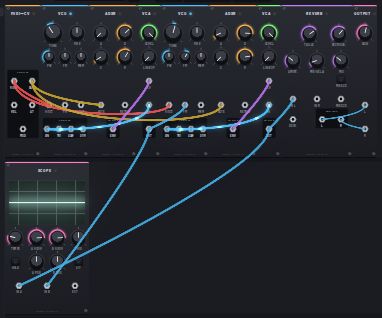
Play the keys: one sine modulates the frequency of another (FM). A short envelope sets how much: the attack shines, then the bell softens. Mod wheel: lengthens the reverb.
Open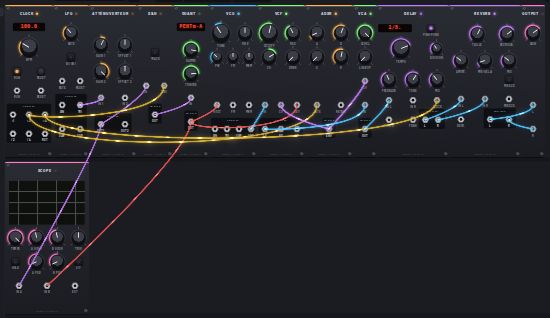
No keyboard needed: a slow LFO, sampled on each note by the S&H, goes into the Quant, which turns it into notes of the scale (A minor pentatonic); the pitch only changes at the start of a note. Dotted-eighth delay and reverb. The Scope shows the ramp and the staircase.
Open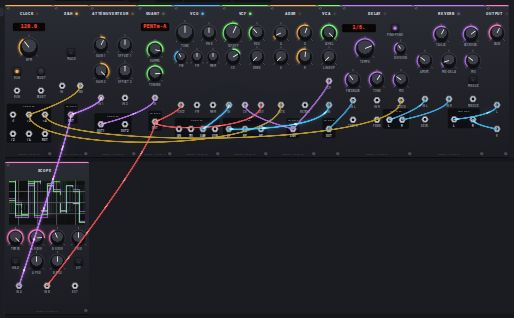
No keyboard needed: with no cable on its input, the S&H picks a random value on each note; the Quant brings it back into the scale (A minor pentatonic), over two octaves. Delay and reverb. The Scope shows the raw random values and their quantized version.
Open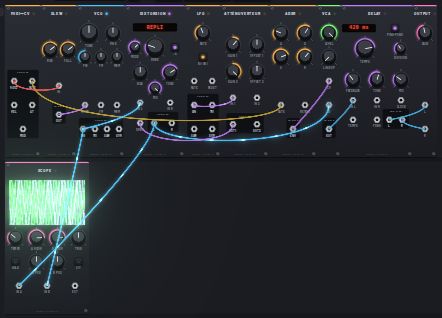
Play the keys: a sine folded by the Distortion (FOLD, “West Coast” synthesis); a slow LFO on DRIVE makes the tone breathe; a Slew glides each note into the next; delay. Mod wheel: feeds the echo until it runs away.
Open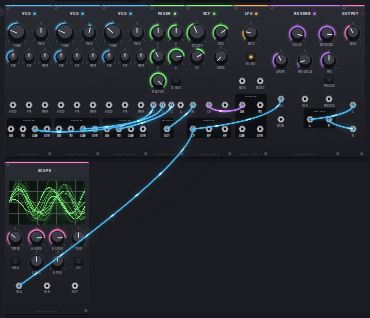
No keyboard needed: three oscillators (a fifth, a slight detune) into a resonant filter that a very slow LFO opens and closes, drowned in a long reverb. Try FREEZE.
Open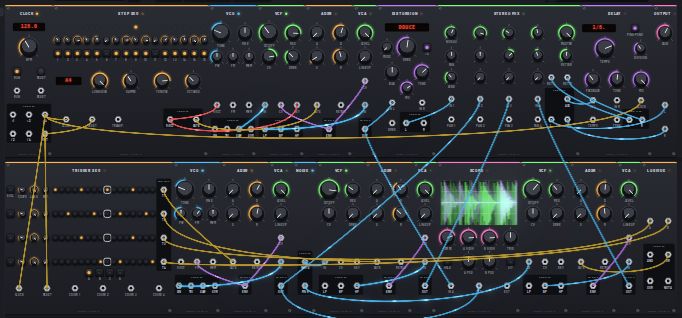
No keyboard needed, 128 BPM: acid bass (very resonant filter opened by a short envelope, driven), kick, hi-hat and snare on the Trigger Seq (a Logic module merges the snare and its fills), delay on an Aux send.
Open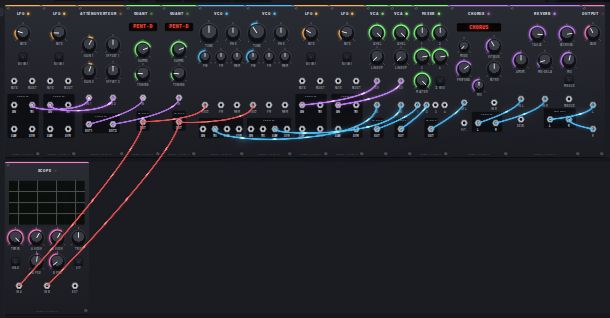
No keyboard or clock: two slow LFOs, quantized to D major pentatonic, sing two voices whose volume rises and falls; chorus and long reverb. It never quite repeats.
Open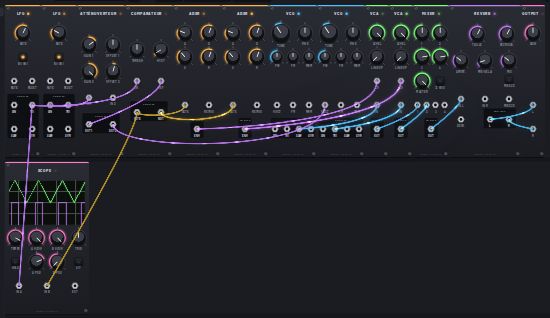
No keyboard needed: the Comparator turns a triangle LFO into rhythm; a very slow LFO on its REF shortens then lengthens the notes, over and over. GATE plays a saw, NOT (the opposite) plays a triangle a fifth up: the two voices take turns. The Attenuverter sets the threshold (channel 1) and gives voice B its pitch (channel 2, no cable: a fixed voltage).
Open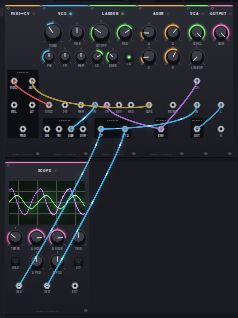
Play the keys: a saw into the Ladder (four saturating poles, ×4 on) whose resonance squelches on every note, like a Moog bass. The Scope compares LP (24 dB per octave, on A) and LP12 (12 dB, on B). Mod wheel: pushes the resonance until it whistles.
Open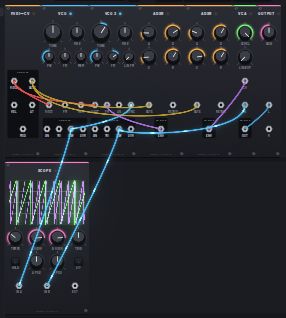
Play the keys: a leader VCO (saw) resets a follower VCO 2 on every cycle; an envelope sweeps the follower’s pitch on each note, yet the pitch you hear stays the same: the screaming sound of hard sync. The Scope shows the leader (A) and the follower (B). Mod wheel: raises the follower, tearing the timbre even more.
Open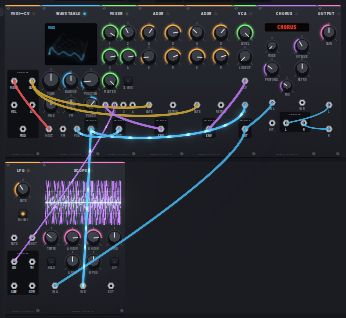
Play the keys, six voices: the Wavetable plays its Voice bank; on each note, an envelope glides the Position from "o" to "ah", then lets it fall back, while a slow LFO keeps it moving. A light Chorus widens it all. Mod wheel: moves the Position on to other vowels.
Open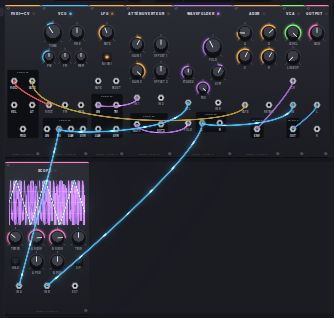
Play the keys: an almost pure triangle goes through the Wavefolder, whose folding is slowly swept by an LFO. The more the signal folds, the richer the tone, without ever getting louder. The Scope compares the triangle (A) and the folded signal (B). Mod wheel: speeds up the LFO into a wobble.
Open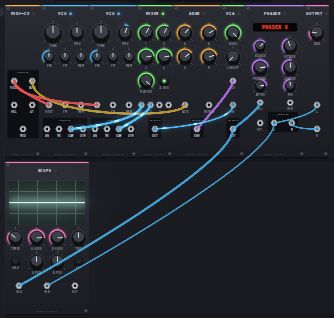
Play the keys: two detuned saws go through an eight-stage Phaser whose feedback makes it sound vocal. Four notches slowly sweep the spectrum, offset between left and right. Mod wheel: speeds up the Phaser sweep.
Open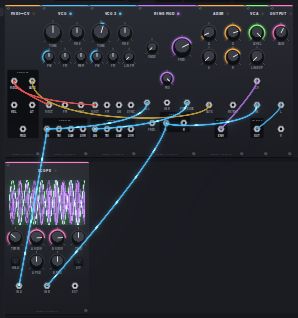
Play the keys: a sine is multiplied by a second sine whose pitch follows the keys at a non-whole ratio (×1.41). Only the sums and differences remain: a metallic, out-of-tune bell that follows the keyboard. Mod wheel: shifts the ratio between the two sines, detuning the bell.
Open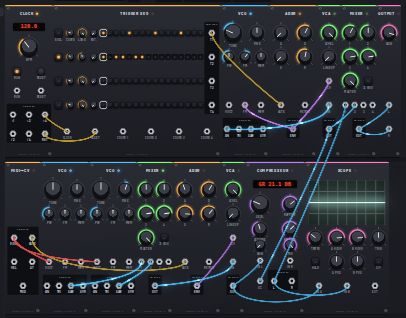
Play the keys: a saw pad that the kick (SC input, the Compressor’s sidechain) squashes on every beat, then lets swell back: the pumping sound of house music. The Scope compares the pad (A) and the compressed pad (B). Mod wheel: detunes the two saws, thickening the pad.
Open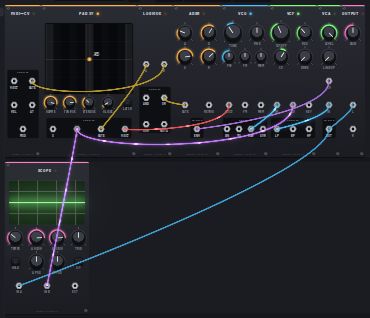
On the Pad XY surface: your finger picks the note across (in minor pentatonic, so every note fits) and opens the filter up and down; touching plays the note. The keys play too, at the pad’s last pitch.
Open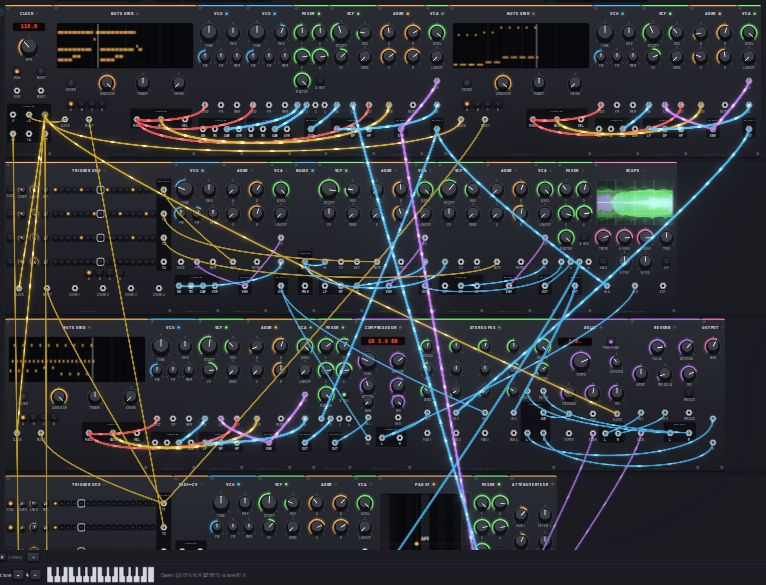
No keyboard needed: the chords of “Everything in Its Right Place” (C, Db, Cm/Eb, one bar of 4/4 then one of 6/4) at 118 BPM, synthwave style. Sixteenth-note saw bass on the roots from the score, with octave jumps, a sixteenth-note arpeggio, four-on-the-floor kick and clap; the pad ducks on every kick (sidechain) then swells back. Dotted-eighth delay and reverb. On the keys, a voice sings “Everything” on top; on the Pad XY, X opens the pad and Y makes the delay and reverb last longer.
Open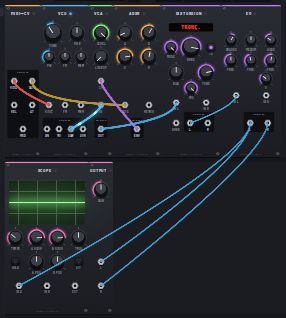
Play the keys: a low driven saw in CHAINSAW mode (asymmetric clipping, an upper-mid bump around 1 kHz), then an EQ that boosts the lows and tames the very top. The “chainsaw” grit of 1980s metal pedals. Mod wheel: pushes the pedal gain all the way up.
Open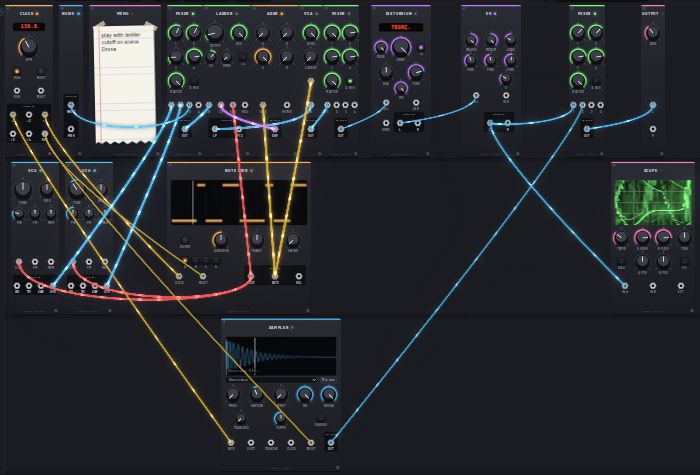
No keyboard needed: an F♯ riff at 130 BPM (Clock and Note Grid) and a kick on every beat, played by a patch set like a Juno-106 (narrow square, sub oscillator, closed filter at full resonance tracking the notes, VCA on Gate), plugged into a 1980s metal pedal set the Swedish way. The voices are summed first (like the cable going into a pedal), then driven in CHAINSAW mode and shaped by the EQ. The noise is turned down: driven, it would turn into hiss. Two scenes: Riff and Drone (the held F♯, filter a little more closed); the Ladder’s Cutoff acts as the bender.
Open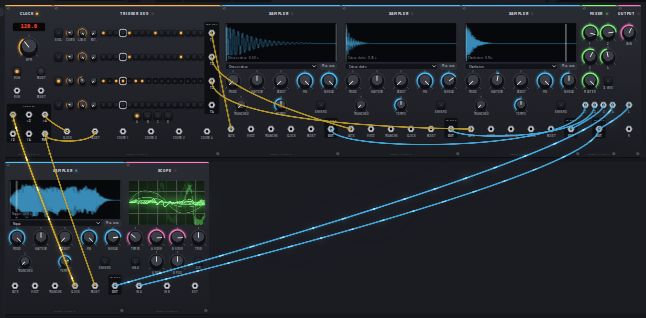
No keyboard needed: drums played by three Samplers (kick, snare and hi-hat from the starter kit), and a looped pad locked to the clock, stretched over two bars.
Open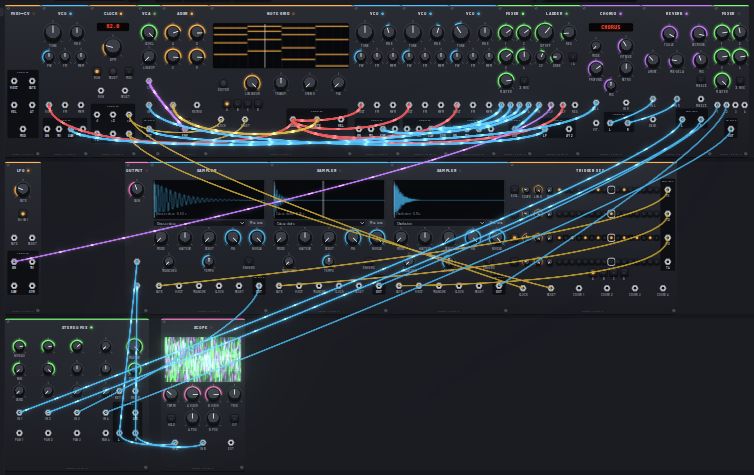
A real track that plays by itself at 82 BPM: chords from four VCOs on the Note Grid (four pages), through a Ladder, a chorus and a big reverb, with drums from the starter kit on the Trigger Seq. Three scenes, Intro, Build and Climax (the filter opens and heats up), are chained as a Song: start it with ▶ in Song.
Open